Pouty Mannheim's Jenny airplane
The Master Butchers Singing ClubPouty Mannheim's Jenny airplane, a war-surplus craft that Pouty maintains and flies over the Waldvogel shop, becomes more than a machine in the lives of Franz and his mother, Eva. Its departure from the earth gives Franz an overwhelming, wordless release; later, it carries Eva on a flight arranged by her son. The ride cannot take away her illness or pain, but it gives her a burst of physical and mental joy, making the airplane’s significance rest in what it enables rather than in any power to heal.
Ownership and Place in the Household
Pouty Mannheim develops a fascination with flight, buys the Jenny, and spends his spare time working on its engine and practicing rolls, dives, and elaborate curving maneuvers. He sometimes buzzes low over the shop, waving to the boys. Fidelis gives him permission to land in the flat field behind the house, so the airplane’s visits become a recurring part of the family’s surroundings rather than a distant spectacle. Its arrival draws Franz out of the butcher shop and into a world organized around the aircraft’s controls, engine, and takeoff.
Pouty keeps an official-looking log of his flights, fuel, and hours in the air. Franz studies it and the plane’s controls while Pouty visits his father. When Mannheim returns to the field, Franz eagerly takes on what he imagines is ground-crew work: turning the propeller and calling the stand-clear. The airplane thus gathers a small routine around itself. Pouty brings the machine, but Franz’s careful attention and physical participation make each departure an occasion he has been waiting for.
Flight and Franz’s Response
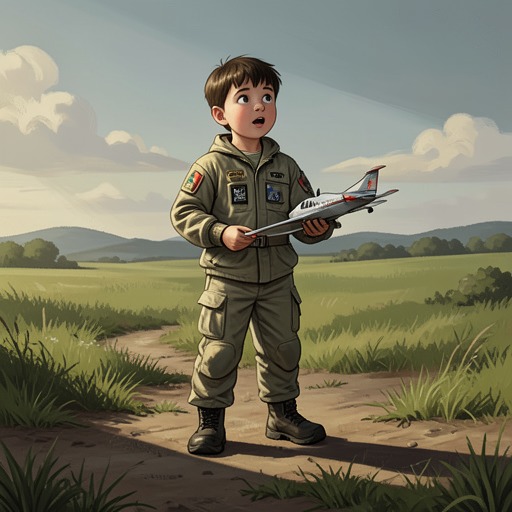
Franz’s response begins before he ever flies. As the Jenny gathers speed, its sway fills him with excitement he does not understand. He runs after it, shouts, and throws his cap as it rises from the field. What holds him is the visible interval opening between the ground and the aircraft: the instant the wheels leave the earth. The experience is so bodily and intense that he can find no language for it, whether in the language of his parents or that of his schoolmates. Afterward, he stands very still for several minutes, privately gathering himself before facing other people.
The contrast between the reserved boy and his unrestrained pursuit of the plane makes flight a release that ordinary speech cannot contain. Franz’s fascination also takes a more sustained form in conversations with Eva. He collects information about different aircraft and their advantages, disparities, and quirks from newspapers and magazines, then talks it through with her. His bed is surrounded by carefully cut and pasted pictures, including a Fokker Eindekker and images of famous aviators. When Eva is ill, she becomes the listener with whom he can speak at length about the subject that most completely absorbs him.
Eva’s Ride
Franz eventually turns his fascination into a plan for Eva. He knows Fidelis will not let her go, so he asks Pouty to keep the arrangement secret from him. Although Pouty is generally self-absorbed and has little experience of affection for his own mother, Franz’s conduct impresses him enough that he agrees. On the morning Fidelis makes his deliveries, Mannheim lands in the field behind the shop. Franz goes to Eva’s room, where she is awake and dressed for the ride, and tells her that her plane has arrived.
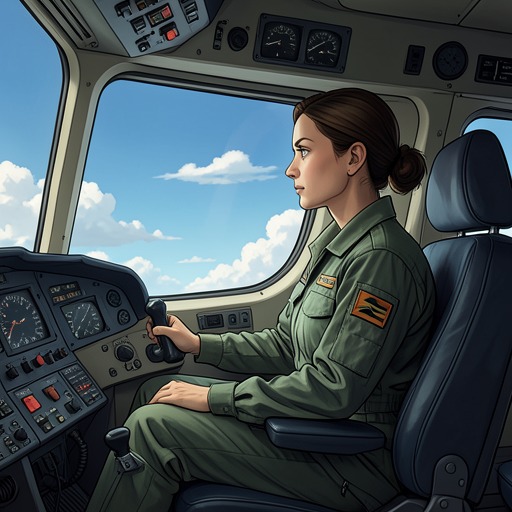
The trip is framed as a gift to a dying woman, but also as a daring act requiring practical care. Franz carries Eva from the house and places her in the seat behind the pilot. When Pouty asks whether she is being held in, Franz jumps behind her seat and wraps his arms around her waist. He starts the propeller; when the engine catches and the plane shakes, he secures her before they move. The machine’s sudden rush across the field carries mother and son into the air together, with Franz experiencing flight not only as something to watch but as something shared with the person closest to him.
Joy Without Cure
Pouty chooses a westward course along the river, hoping to show Eva herons and fish hawks. He has imagined that the ride might make him a hero in Fidelis’s eyes and even wonders whether the thrill of flight could cure Eva. That hope belongs to his faith in the power of flight, not to any outcome the episode confirms. From above, the river appears as a gleaming gray curve, the water narrowing to a string of mercury; trees, roads, and drought-stricken fields become shapes seen from a new height. The aircraft’s motion and the altered view give the ride its extraordinary force.
Eva has also hoped that the excitement might make her pain disappear. It does not: in some ways the pain intensifies. But the joy intensifies too, and she later describes to Delphine not only the physical pleasure of being aloft but the mental pleasure of it. The flight is therefore neither a cure nor a simple escape from illness. Its value lies in the vividness it makes possible, even as Eva’s body remains sick. Once back on the ground, Franz carries her to bed, where she is left shuddering with both happiness and pain.
Narrative Significance
The Jenny airplane connects three distinct experiences of flight: Pouty’s technical enthusiasm, Franz’s almost inexpressible response to takeoff, and Eva’s brief, shared passage through the sky. The machine matters because its material capabilities alter what these characters can do. It can land in the field, accelerate, lift a passenger from the ground, follow the river, and return when fuel runs low. Those actions make the episode possible; the airplane is not merely a symbol placed beside the characters’ feelings.
At the same time, the ride’s limits are essential to its meaning. Pouty’s belief that flight might cure Eva is not fulfilled, and the landscape’s height and motion do not erase her illness. Instead, the airplane gives mother and son a concentrated experience that holds joy and pain together. Franz’s lifelong-seeming wonder at the moment of lift-off becomes an act of care, while Eva’s time in the air grants her pleasure and fresh mental exhilaration without pretending that death has been defeated.